
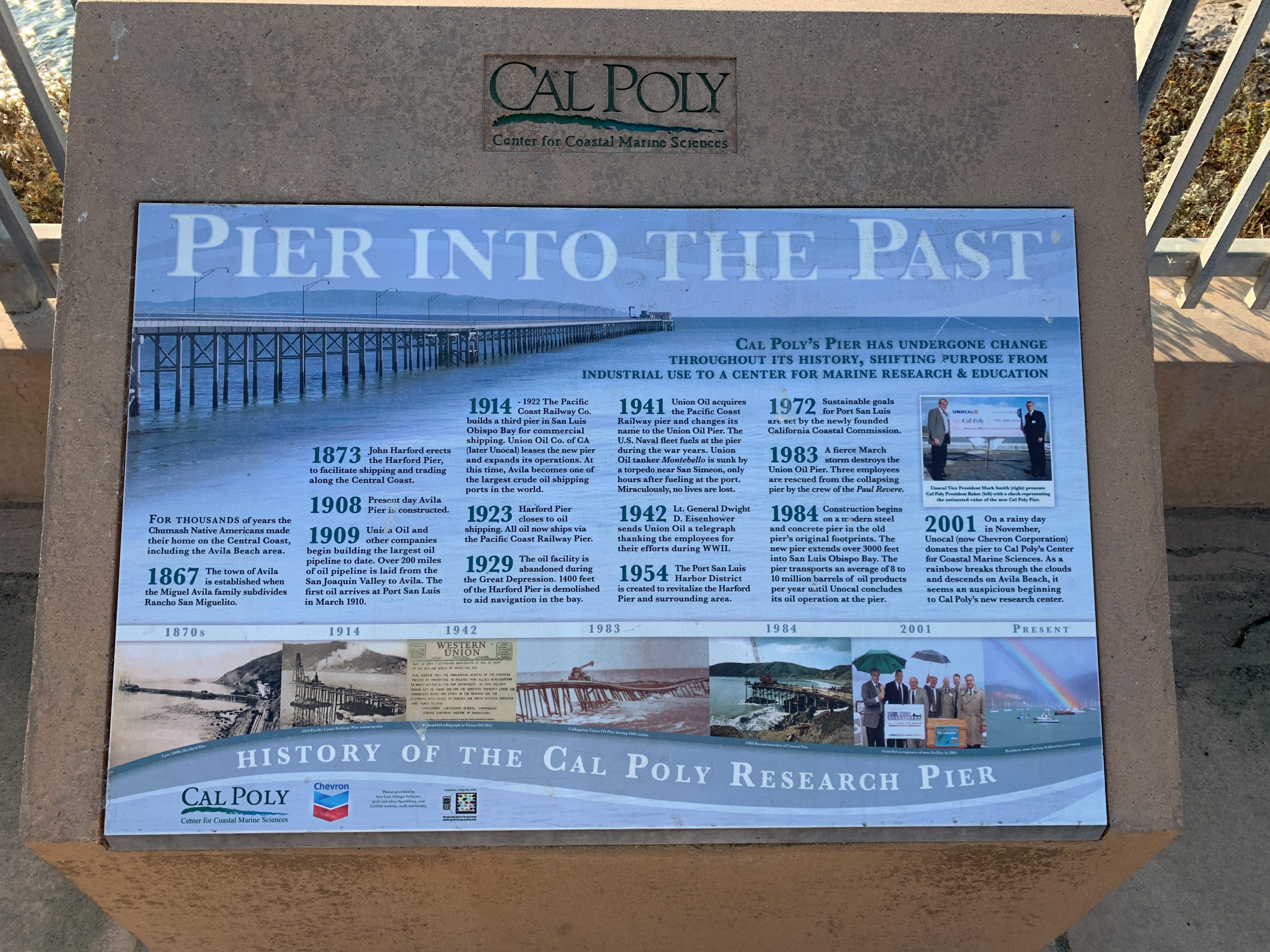
History of the Cal Poly Research Pier
Cal Poly Center for Coastal Marine Sciences
PIER INTO THE PAST
Cal Poly’s pier has undergone change
throughout its history, shifting purpose from
industrial use to a center for marine research & education
FOR THOUSANDS of years the
Chumash Native Americans made
their home on the Central Coast,
including the Avila Beach area.
1867
The town of Avila
is established when
the Miguel Avila family subdivides
Rancho San Miguelito.
1873
John Harford erects
the Harford Pier,
to facilitate shipping and trading
along the Central Coast.
1908
Present day Avila
Pier is constructed.
1909
Union Oil and
other companies
begin building the largest oil
pipeline to date. Over 200 miles
of oil pipeline is laid from the
San Joaquin Valley to Avila. The
first oil arrives at Port San Luis
in March 1910.
1914–1922
The Pacific Coast
Railway Co.
builds a third pier in San Luis
Obispo Bay for commercial
shipping. Union Oil Co. of CA
(later Unocal) leases the new pier
and expands its operations. At
this time, Avila becomes one of
the largest crude oil shipping
ports in the world.
1923
Harford Pier
closes to oil
shipping. All oil now ships via
the Pacific Coast Railway Pier.
1929
The oil facility is
abandoned during
the Great Depression. 1400 feet
of the Harford Pier is demolished
to aid navigation in the bay.
1941
Union Oil acquires
the Pacific Coast
Railway pier and changes its
name to the Union Oil Pier. The
U.S. Naval fleet fuels at the pier
during the war years. Union
Oil tanker Montebello is sunk by
a torpedo near San Simeon, only
hours after fueling at the port.
Miraculously, no lives are lost.
1942
Lt. General Dwight
D. Eisenhower
sends Union Oil a telegraph
thanking the employees for
their efforts during WWII.
1954
The Port San Luis
Harbor District
is created to revitalize the Harford
Pier and surrounding area.
1972
Sustainable goals
for Port San Luis
are set by the newly founded
California Coastal Commission.
1983
A fierce March
storm destroys the
Union Oil Pier. Three employees
are rescued from the collapsing
pier by the crew of the Paul Revere.
1984
Construction begins
on a modern steel
and concrete pier in tie old
pier's original footprints. The
new pier extends over 3000 feet
into San Luis Obispo Bay. The
pier transports an average of 8 to
10 million barrels of oil products
per year until Unocal concludes
its oil operation at the pier.
2001
On a rainy day
in November,
Unocal (now Chevron Corporation)
donates the pier to Cal Poly's Center
for Coastal Marine Sciences. As a
rainbow breaks through the clouds
and descends on Avila Beach, it
seems an auspicious beginning
to Cal Poly's new research center.
Photo caption:
Unocal Vice President Mark Smith (right) presents
Cal Poly President Baker (left) with a check representing
the estimated value of the new Cal Poly Pier.
Submitted by: Eric Goodill
Nearby Plaques
Loading…