
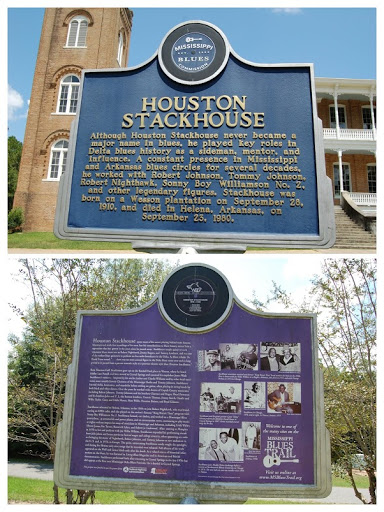
Houston Stackhouse
Born Houston Goff, Stackhouse grew up on the Randall Ford place in Wesson, where he heard fiddler Lace Powell, and later moved to Crystal Springs and assumed his stepfather James Wade Stackhouse's surname. Inspired by his uncles Luther and Charlie Williams and by other local musicians, most notably Lonnie Chatmon of the Mississippi Sheiks and Tommy Johnson, Stackhouse learned violin, harmonica, and mandolin before settling on guitar, often playing in string bands for both black and white dances. Over the years he worked with dozens of Copiah County musicians, including Robert Johnson, Tommy Johnson and his brothers Clarence and Mager, Floyd Patterson and his brothers John and T. J., the Stewart brothers, Cootsie Thomas, Jimmy Smith, Charlie and Willis Taylor, Carey and Eddie Mason, Mott Willis, Houston Boines, and Boyd Gilmore.
Stackhouse relocated to Helena, Arkansas, in the 1940s to join Robert Nighthawk, who was broadcasting on KFFA radio, and also played on the station's famous "King Biscuit Time" program with Sonny Boy Williamson No. 2. Stackhouse farmed, cut timber, and worked on a Mississippi River quarterboat, at automobile and power plants, and on construction crews, continuing to play music at nights with an impressive array of musicians in Mississippi and Arkansas, including Little Walter, Elmore James, Ike Turner, Roosevelt Sykes, and Robert Jr. Lockwood. After moving to Memphis in 1970 to live and perform with Joe Willie Wilkins, Stackhouse expanded his performing circuit from juke joints and house parties to festival stages and college concerts, often appearing as a solo act bringing the music of Nighthawk, Robert Johnson, and Tommy Johnson to new audiences in the U. S. and, in 1976, in Europe. The quiet, unassuming Stackhouse rarely sought the spotlight, and during his lifetime only nine songs that he recorded were released. Full albums of his work appeared on the Wolf and Genes labels only after his death. As a valued source of historical information on the blues, he was featured in Living Blues Magazine and in American and British documentaries. Stackhouse performed little after returning to Crystal Springs in the late 1970s but did appear at the first two Mississippi Delta Blues Festivals. He is buried in Crystal Springs.
Nearby Plaques